
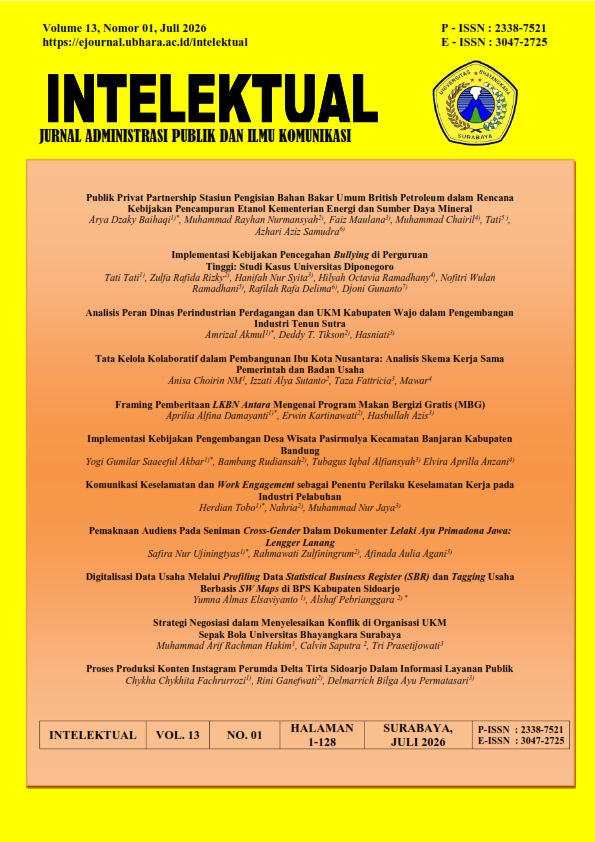
Komunikasi Keselamatan dan Work Engagement sebagai Penentu Perilaku Keselamatan Kerja pada Industri Pelabuhan
Article Sidebar
Main Article Content
Abstract
Occupational safety is a critical issue in high-risk work environments, such as container terminal operations. This study aims to analyze the effect of effective communication on employees’ safety behavior, with work engagement as a mediating variable at PT Pelindo–Peti Kemas Jayapura. The research employed a quantitative approach with an explanatory research design. The population comprised all employees of PT Pelindo–Peti Kemas Jayapura, using a saturated sampling technique with 94 respondents. Data were collected through Likert-scale questionnaires and analyzed using path analysis with SPSS. The results indicate that effective communication has a positive and significant effect on employees’ work engagement. Furthermore, both effective communication and work engagement have a direct positive and significant impact on safety behavior. The findings also confirm that work engagement mediates the relationship between effective communication and safety behavior. This study highlights that clear, open, and participative communication not only enhances employees’ psychological engagement but also fosters consistent safety behavior in daily operations. Practically, these findings provide important implications for management in strengthening safety culture through effective safety communication systems and enhancing employees’ work engagement in high-risk industrial settings.
Article Details
Section

This work is licensed under a Creative Commons Attribution-NonCommercial 4.0 International License.
Authors who publish with Intelektual: Jurnal Administrasi Publik dan Ilmu Komunikasi agree to the following terms:
- The author retains copyright licensed under Creative Commons Attribution-NonCommercial 4.0 (CC BY-NC 4.0), which allows others to remix, adapt, and expand on the author's work non-commercially, and even if someone else's new work must also acknowledge the author and is non-commercial, they do not need to license their derivative works on the same terms.
- Authors are permitted and encouraged to post their work online (e.g., in institutional repositories or on their websites) before and during the submission process, as this can lead to productive exchange, as well as earlier and greater citation of the published work ( See Impact of Open Access). Authors can archive preprints and postprints or publisher/PDF versions.
How to Cite
References
Ansori, N., Widyanti, A., & Yassierli. (2021). The Role of Safety Silence Motives to Safety Communication and Safety Participation in Different Sectors of Small and Medium Enterprises: Investigation Results on Two Kinds of Industries in Indonesia. Safety and Health at Work, 12(2), 192–200. https://doi.org/10.1016/j.shaw.2020.10.001 DOI: https://doi.org/10.1016/j.shaw.2020.10.001
Bawono, A. (2013). Multivariate Analysis dengan SPSS. STAIN Salatiga Press.
Ghozali, I. (2019). Aplikasi Analisis Multivariate dengan Program SPSS. Journal of Chemical Information and Modeling. https://doi.org/10.1017/CBO9781107415324.004 DOI: https://doi.org/10.1017/CBO9781107415324.004
Hertanto, A., Erwandi, D., Widanarko, B., & Tejamaya, M. (2023). Relationship between Safety Climate and Safety Behavior in Company X in Indonesia. Safety, 9(4), 1–20. https://doi.org/10.3390/safety9040089 DOI: https://doi.org/10.3390/safety9040089
Ma, F., Zhu, Y., Liu, L., Chen, H., & Liu, Y. (2023). Work Engagement and Safety Behavior of Nurses in Specialized Cancer Hospitals: The Mediating Role of Self-Efficacy. Journal of Nursing Management, 2023, 1–9. https://doi.org/10.1155/2023/9034073 DOI: https://doi.org/10.1155/2023/9034073
Rahmadani, V. G., & Schaufeli, W. B. (2022). Engaging leadership and work engagement as moderated by “diuwongke”: an Indonesian study. International Journal of Human Resource Management, 33(7), 1267–1295. https://doi.org/10.1080/09585192.2020.1799234 DOI: https://doi.org/10.1080/09585192.2020.1799234
Rusyda, H. M., & Aziz, S. F. A. (2021). The Development of Safety Behavior: A 30-Year Review. International Journal of Academic Research in Economics and Management Sciences, 10(1), 46–71. https://doi.org/10.6007/ijarems/v10-i1/9212 DOI: https://doi.org/10.6007/IJAREMS/v10-i1/9212
Saleem, M. S., Isha, A. S. N., Yusop, Y. M., Awan, M. I., & Naji, G. M. A. (2022). The Role of Psychological Capital and Work Engagement in Enhancing Construction Workers’ Safety Behavior. Frontiers in Public Health, 10. https://doi.org/10.3389/fpubh.2022.810145 DOI: https://doi.org/10.3389/fpubh.2022.810145
Sridadi, A. R., Himmawan, M. F., Ninglasari, S. Y., & Fiqqih, M. N. (2024). The Mediating Role of Workplace Safety Climate on Safety Leadership and Safety Knowledge in Indonesian Petrochemical Employees. Journal of Behavioral Science, 19(2), 75–88.
Sugiyono. (2018). Metode Penelitian Kombinasi (mixed Methods). In Alfabet.
Tanzeh, A. (2011). Pengantar Metodologi Penelitian. Teras.
WHO & ILO. (2021). The new WHO/ILO Joint Estimates of the Work-related Burden of Disease and Injury, 2000-2016. In WHO & ILO (Vol. 13). https://doi.org/10.1016/j.shaw.2021.12.713 DOI: https://doi.org/10.1016/j.shaw.2021.12.713
Widiyanto, M. (2022). Pengaruh Komunikasi Organisasi terhadap Work Engagement melalui Kepuasan Kerja pada Karyawan UniversitasTrisakti. Jurnal Pendidikan Islam dan Multikulturalisme, 4(3), 900–919. DOI: https://doi.org/10.37680/scaffolding.v4i3.2133
Zara, J., Nordin, S. M., & Isha, A. S. N. (2023). Influence of communication determinants on safety commitment in a high-risk workplace: a systematic literature review of four communication dimensions. Frontiers in Public Health, 11(August). https://doi.org/10.3389/fpubh.2023.1225995 DOI: https://doi.org/10.3389/fpubh.2023.1225995